You NEED to do this! It’s POWERFUL but SIMPLE!!

6 Comments »

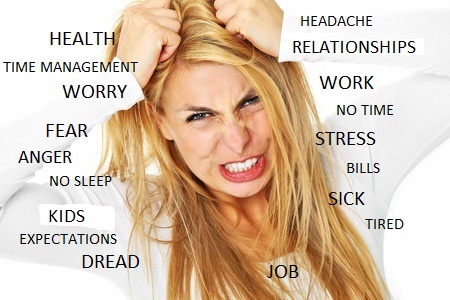
17573308 - a picture of a young depressed woman tearing out her hair over white background

Stress is an unavoidable part of life.

Not all stress is bad for you.  Some stress helps you to perform better.
But chronic stress – the kind a lot of people face day in and day out – can be destructive.


The Dangers of Stress:

Up to 90% of doctors’ visits are due to stress.
When you’re stressed, the enemy–Cortisol, is running through your system all day long.
Over time, cortisol wears out your immune system and can lead to weight gain, digestive problems, cancer, heart disease, and diabetes.
Cortisol can leave you exhausted and tired–prone to mood swings and poor sleep.
 

The Effects of Chronic Stress


Here are 8 ways chronic stress negatively impacts your well-being.


1. Chronic stress makes you forgetful and emotional.

Stress decreases your ability to think factually and increases your emotional reactivity.

2. Stress  creates a vicious cycle of fear and anxiety.

3. Stress halts the production of new brain cells.

Every day you lose and create new brain cells, but cortisol halts the production of new cells being formed which can lead to a decrease in your ability to think.

4. Stress  depletes critical brain chemicals 

Chronic stress reduces serotonin and dopamine. (the feel good hormones) and can leave you depressed and more prone to anxiety, addictions, sleeping problems, binge eating, and trouble with impulse control.

5. Stress creates havoc in your relationships 

Stress predisposes you to being irritable and frustrated with other people in your life.

6. Stress zaps your thinking process

Stress can cause your brain to seize up at the worst possible times – exams, job interviews, and it diminishes your ability to problem solve.

7. Chronic stress shrinks your brain.

Stress can measurably shrink your hippocampus and prefrontal cortex which is responsible for decision making and control of impulsive behavior.
It can increase your risk for dementia and Alzheimer’s.

8. Chronic stress leads to unhappiness

It wears you down mentally and emotionally, and saps the joy from life.

Stress increases the size of your amygdala, which increases fear and anxiety.

Other Side Effects of Stress:


  • excessive worry and fear
  • anger and frustration
  • impatience with self and others
  • mood swings, crying spells or suicidal thoughts
  • insomnia, nightmares, disturbing dreams
  • trouble concentrating and learning new information
  • racing thoughts, nervousness
  • forgetfulness, mental confusion
  • difficulty in making decisions
  • feeling overwhelmed
  • irritability and overreaction to petty annoyances
  • excessive defensiveness or suspicion
  • increased smoking, alcohol, drug use, gambling or impulse buying

It’s no fun experiencing these stress symptoms. 

It’s no picnic for those around you either

.

Mindfulness has been proven

to help turn stress around and mitigate it’s effects on the brain. 


Here is one mindfulness exercise that needs to become a priority in your life.


Brain research has proved its benefits over and over.


Breathing Stress Relief Technique:

This breathing exercise stimulates the parasympathetic nervous system which helps bring about a state of TRUE CALM.
The more you practice this, the more you will train your body to relax.
.

Diaphragmatic Breathing Exercise

1.  Sit comfortably or lie down.
2. Then slowly inhale through your nose (like you’re smelling a flower)
3. Slowly exhale through your mouth (like you’re blowing out birthday candles)
4. Do this breathing exercise 2x per day for ten to fifteen minutes to reduce stress and anxiety
Research shows that this breathing exercise will physically change the structure of your brain and help alleviate stress!
It seems so simple but don’t underestimate it’s value.

If you’d like to learn more mindfulness techniques to conquer stress and overwhelm in your life, contact Fay to learn about her 6 week mindfulness program.

e-mail: fay@fayprairie.com
.

Ever Played This Game? It’s One you Can’t Win!

12 Comments »

48338287 - game night words on a board game with pieces moving around in fun competition

Ever found yourself saying?

  • “They don’t do their fair share,”
  • “He/she blows up over nothing”
  • “They’re not even trying”
  • “They don’t even care.”

It doesn’t feel good to be blamed, and most people fight back.

  • “You don’t even notice how much I do”
  • “I blow up because you provoke me”
  • “I work harder than anyone else”
  • “You have no idea how much I care”

Blame is a game you can’t win!

People get stuck in a vicious blame cycle. The more you blame, the worse you both feel and the worse it seems to get.

When you blame, you start to feel like a powerless victim.  After all, since it’s their fault, there’s nothing you can do.

Blame does the opposite of what you want.  It actually helps things to stay the same, or even makes them worse.  Blame sends out a negative energy which brings you back more negative energy.

Some people blame their partner for their unhappiness yet find themselves in another unhappy relationship.  Some people leave a job they can’t stand only to end up in another job they can’t stand.

We think if only the other person or situation changes, then things will be better.

It’s like the man who decided to move across the ocean to get away from everything that was making him unhappy but when he got there, he was still unhappy because he had brought himself with.

Sometimes, instead of blaming, we need to look inside ourselves and ask ourselves these five questions.

  1. What can I learn from this? How can I become a better person?

View the situation as something to help you learn and grow. When you blame, you miss the opportunity for self-reflection and growth.

When you get triggered, become mindful and investigate it.

  • Does my reaction seem like an overreaction?
  • Could it have anything to do with my past?
  • What inside of me is causing me to react this way?

Example:

Carol often complained that her husband would retreat from solving problems, and she realized that his pattern was similar to her father’s, who could never make a decision.

She then recognized that just like her mother, she had the tendency to nag and push to get a reaction from her husband, which pushed him further and further away.

When she opened up to him about this realization, he revealed that his defense since he was a young boy was to get quiet and retreat when confronted.

Carol was able to learn that her being forceful and demanding was actually triggering him to be more indecisive.


2. How did I help create this situation? What role did I play?


This doesn’t mean someone else didn’t play a part but take responsibility and focus on your part and what you can change. This will help you let go of the blame game.

When you feel criticized, take a few minutes to acknowledge your part of the problem, however small.


  • If “he/she doesn’t do their share,” can you acknowledge how bringing it up every day contributes to their digging in their feet?
  • If he/she “blows up over nothing,” can you see how a small comment you made helped set off the spark?


3. How can I think and look at this situation in a different way?


“When you change the way you look at things, the things you look at change.”

View the situation from a different perspective—it’s a powerful tool.

Is there another way to interpret what’s being played out and what’s happening?

Sometimes it’s good to get another person to help you see and interpret the situation in a different way.


4. Am I trying to control this situation too much? Am I trying to make sure things go my way? Do I need to lighten up and let go?


Trying to control the problem—your boss, your spouse, or your circumstances will only keep you more attached to it.  The more you “leech” onto a problem, the more it “leeches” back on you.

You will never be able to see the lesson or the solution if you dwell on all the little details about what’s going wrong.

Letting go can be: seeing the good in the other person, accepting a situation for what it is, or seeing the other side of the story.

When we let go of our attachment to what went wrong or what should have happened, we pave the way for more positive results.


5. How can I listen and really try to understand how they are seeing and feeling about this?


Have compassion.  When we truly try to understand both sides of the story, the reason why we both get triggered, we have more compassion for ourselves and them.

When you try to see the scenario from their eyes and understand how they view the situation, it’s easier to have empathy and understanding even if you don’t agree.


It helps soften your mood, and there’s more room for conversations that focus on solutions.  You’ll both feel much better.

  • “If that’s how you see it, I can understand why you are feeling upset.”
  • “I’m sorry it happened that way.”


Blaming harms relationships!

It creates distance and disconnection.

It’s obviously difficult to get close to someone or to maintain a close relationship when they have their arm outstretched with an accusing finger.

The act of blaming results in defensive behavior and bitter feelings.

When both people are blaming, it’s a double negative on the relationship.

Here are some challenging questions you can use as your guide.


What action can I take that doesn’t depend on what the other person says or does?


Can I talk about my own experience without blaming the other person?


Can I get curious about understanding how they feel and how they see it, even if I don’t agree?


Can I let go of the need to be right?


“Let us not seek to fix the blame for the past. Let us accept our own responsibility for the future.”

What’s one of the biggest SECRETS to health and happiness?

Leave a comment »

49176010 - chalk board writing of enjoy life written on green blackboard over textured wall

What’s the secret to health and happiness?

 Try these 7 strategies to move you in the right direction!


“Good Relationships”

are at the top of the list!

Research Shows:

  • People who are more connected with other people are happier, physically healthier, and live longer.
  • The quality of your relationships is more important than the quantity. 
  • Relationship satisfaction can predict future health.
  • A good relationship DOES NOT mean zero bickering. There are ups and downs, but trust, commitment and respect are key.
  • Loneliness can be toxic; people who are isolated are less happy, their health declines sooner and their brain function declines sooner.

TAKE AWAY

TAKE TIME TO NURTURE  YOUR RELATIONSHIPS!

YOUR HAPPINESS DEPENDS ON IT!


It can be challenging when life gets busy and let’s face it–at times, relationships are really “messy” and “challenging.”

WHAT EFFORT CAN YOU MAKE TODAY TO NURTURE YOUR RELATIONSHIPS

(Personal and Professional)


SEVEN WAYS TO NURTURE YOUR RELATIONSHIPS

  1. Make time for visiting with each other.  The more time you spend sharing and learning about each other’s lives, the closer you will be.  When life gets busy, it’s too easy to let this slide to the back burner and forget it’s importance.


  1. Face and be willing to work through difficulties and disagreements. Have those difficult conversations! Although they can be uncomfortable, they can be positive and help us connect and grow. Burying them can have disasterous effects; they add up over time and come back to haunt you!


  1. Schedule fun time together! Discuss what you like to do, where you’d like to go, and then GO DO IT!  We all need a break from life’s daily routine.


  1. Offer emotional support, validation and compliments. It’s important to lift each other up and let them know how much you care.  Knowing someone truly cares means so much!


  1. Practice Compassion, Acceptance and Forgiveness.  There are some things we just cannot change, and that’s when these three powers will help us get to the other side of challenges.


  1. Step outside the box.  Be willing to think and try a different way even thought it’s not “your way.”


7. Admit mistakes and talk about them.  We all screw up.  Learning to understand and let go of mistakes that you or the other person make will turn your life around. It will give you more time to enjoy life and each other.

Which one will you choose to work on today?

Practice one each day!

When our relationships feel good, we feel good and when we feel good, we do better in every area of our life!

Fay works with individuals, couples and organizations to inspire and create positive, upbeat mindsets and peaceful connected relationships, both with yourself and others!

Contact Fay to set up a free, no obligation 30 minute consultation to learn more about her coaching services, relationship/mindset programs and speaking topics–507-829-0181 or email fay@fayprairie.com

Join Fay on Facebook: www.facebook.com/PrairiePerspectives/

Gift yourself this for Valentines Day!

Leave a comment »

valentineMost of us are in constant mental chatter all day long, and, unfortunately, this self talk is frequently negative.


Often it is tainted with guilt about our past, comparing ourselves to someone else or anxiety about our future.


This negativity can make us feel ‘less than,’ ‘disappointed,’ ‘frustrated,’ or ‘anxious.’


“Why did I do that” 

“Boy, that was stupid” 

“Why can’t I be better looking, smarter, faster, more efficient, more energetic….” (and the list goes on and on)


“I doubt I can accomplish that” 

“It will probably be a disaster”

“I just can’t get it all done”

“I’ll never figure it all out”


Never say anything about yourself that you don’t want to be true.

If you don’t talk to yourself in a positive way, you have an automatic default setting which causes you to think about your worries, doubts, problems, and concerns. 

Your internal dialogue determines 95% of how you feel, and you believe what you continually repeat to yourself.


Your mind is extremely powerful!

It’s like driving down the street and you can steer your car to go left or right.

If you don’t deliberately steer the wheel towards the positive, you’ll default to the negative.

Three of the most positive words you can say to yourself are:

I like myself!

I like myself, I like myself, I like myself! 

Repeat it over and over.

  • Prior to answering the phone, I like myself!
  • Prior to completing a project, I like myself!
  • Prior to a conversation, I like myself!


Be your own cheer leading session.

I like myself

I like myself

I like myself

I like myself


You can’t say I like myself without feeling more confident, inspired and positive.

The more you like yourself, and the more you like other people, the more they’ll like you right back and they’ll want to be associated with you.

Repeat it over and over several times a day.

“I like myself, I like myself, I like myself”

I really, really like myself!