How STRONG of a Bully is your Inner Critic?

Leave a comment »

abusive or bullying words in a symbolic fist shape.Have you ever heard that STRONG, POWERFUL VOICE  that tells you how inadequate you are? 

It’s like an infared tracking system that tracks everything you do WRONG, and lets you know about it.  It’s a voice that PUNISHES and CUTS YOU DOWN for every mistake you make and DOWNPLAYS every accomplishment you’ve ever achieved.

It makes you question everything about yourself.

  • You’re not good enough!

  • You’re not smart enough!

  • You’re not fast enough!

  • You should be like him/her!

  • What’s wrong with you?

  • Why can’t you get it right?

  • You are so stupid!

  • Why can’t you be more like other people?

  • You don’t belong!

  • You’re not wanted!

  • You’re too skinny!

  • You’re too fat!


The message is consistent.  You’re not good enough!  A bully may say it to YOU once or twice, but YOUR inner critic repeats it another 100x. 

Whatever gets repeated in your mind over and over tends to become a BELIEF, even when it’s not true.

EVERYONE has an inner critic; for some it’s just STRONGER than others.  Sometimes, its been playing in the background for so long that you don’t even hear it or pay attention to it, yet it STEALS your PEACE and JOY by diminishing your self-esteem. 

It ROBS you of your CONFIDENCE, makes you DOUBT yourself and your abilities.  Once your inner critic CRITICIZES you, you are open and vulnerable to that same criticism from others.  It makes you FEAR that you’ll  be found unacceptable to others; fear that you’ll be rejected .

Our inner critic can be a relentless BULLY.

The sad thing is that no matter how distorted and false our inner critics attacks may be, WE ALMOST ALWAYS BELIEVE THEM! 


Which Type of Communicator are You?

Leave a comment »

assertiveness aggressivenessOne thing I’ve definitely learned in life: Whether it’s a bullying situation, getting along with co-workers, friends or family members, ASSERTIVE COMMUNICATION is an essential skill!

Following are four types of communication:  Which one do you use most frequently

1. Passive

Avoid saying what you think, feel, want, or believe.  Avoid confrontation at all costs.

Examples:

You really want to go to the movies tonight but your partner wants to go to the races.  You say it doesn’t matter but all night you feel slighted because you always do what he wants.

Your co-worker divides your shared workload and it seems you always get the most difficult accounts.  Even though you feel resentful, you tell yourself it doesn’t matter and remain quiet and do the work.

You’re upset that she keeps ignoring you and calling you names, but you don’t want to make any waves so you just keep quiet.

By not standing up for yourself, you feel weakened, you begin to feel like a victim and harbor resentment.

2.  Aggressive

Saying what you think, feel, want or believe in ways that are hurtful and disrespectful to others (belittling, degrading, threatening, blaming, yelling).

Examples:

“Put your #$* socks in the #$* wash. You are such a slob. The house looks like a pigsty, because of you.”

“You’re so stupid-you can’t you do anything right?”

“Are you crazy, you don’t even know what you’re talking about! Try to get it right next time!”

When you handle your relationships with aggression, you may feel that it works in the short term, but; ultimately, you push people away and they may fear you but they don’t respect you!

3. Passive/Aggressive

This is aggression but instead of being verbal, you are aggressive with your actions in a sneaky, underhanded way.

Examples:

Sondra is upset about an unwanted job her boss gave her, frustrated because she got it versus her co-workers.  She doesn’t say a word to her boss, but each morning she makes his coffee purposely strong knowing that he doesn’t like it that way.

Jen’s roommate made her favorite food for dinner tonight.  Jen thinks, “After the way she acted towards me, I’m not going to eat, no matter how hungry I am.”

Katy is upset with a friend. She thinks, “I’ll show her,” and doesn’t talk to her all day plus she gets the other girls in the class to ignore her too.

People who are passive aggressive can be very difficult to get along with.

4. Assertiveness

Saying what you think, feel, want, or believe in a respectful, straightforward manner.

Examples:

“I feel it’s unfair that you get to decide what we do the majority of the time.  I really need you to do some things that I’d like to do.”

“I feel really hurt when you talk that way; I need you to be more respectful to me!”

“I feel irritated when I get the most difficult accounts; I need you to divide the work up in a way that is more equal.”

Sondra tells her friend, “I feel hurt when you decide to just ignore me.  I need you to let me know why you’re so upset and angry.”

The ultimate goal is to use ASSERTIVE COMMUNICATION in your relationships.

You tell the person how you feel when they do what they are doing or saying and then you tell them what you would like to happen.

Assertive communication starts out with an “I” statement, and ends with telling the other person what you would like to happen.

I feel______________________________________________

When _____________________________________________

What I would like is __________________________________


For people who have developed habits of being passive or aggressive, this type of communication can seem awkward and uncomfortable.  But each time you practice, it will become easier. 

Tying your shoes is easy because you’ve done it a thousand times.  The same is true of learning to use most new skills. 

Remember, we often resist that which is uncomfortable, but if we want SOMETHING TO CHANGE, WE NEED TO MAKE CHANGES IN OURSELVES! 

So today, begin to practice using ASSERTIVE COMMUNICATION SKILLS.  The benefits will be worth it!

I’m AWESOME!

Leave a comment »

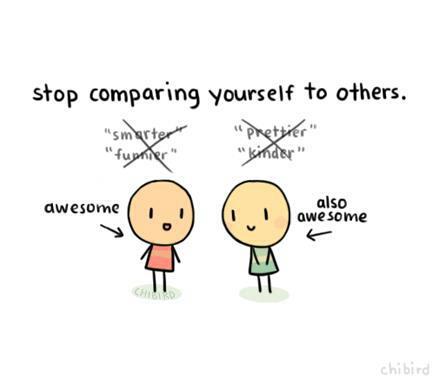
stop comparing yourself to othersHave you ever worried about what other people think about you?  Have you compared yourself to others and come out way beneath them?

I bet you’re shaking your head, “yes.” It’s time to change your mindset… Today, the only person you should try to be better than is the person you were yesterday.

You are GOOD enough, SMART enough, FINE enough, and STRONG enough.

You don’t need other people to validate you; you are already valuable.

If someone says something negative about you, that doesn’t change anything about YOU.

The words and opinions of others have no real bearing on your worth.

It’s great to receive positive feedback, but it simply doesn’t always happen. We need to learn to give the positive feedback we need from others to ourselves.

Know and believe that your true worth does not depend on the judgment of others.

There will be those who disagree with you, those who ignore you, and those who flat out reject your ideas and efforts. Look beyond them, step confidently forward, do what must be done, and let them think what they will.

“You have been criticizing yourself for years, and it hasn’t worked. Try approving of yourself and see what happens.” ~Louise L. Hay

Start with these two strategies to love and appreciate yourself more!

1. Make a daily gratitude journal in which you appreciate yourself.


Write down good things that have happened in your day.

Note the things you’ve done well, the choices you’ve made that you’re proud of, the progress you’ve made, and even just the things that you felt happy about during your day.

When you regularly praise yourself and notice your successes, self-validation becomes a habit vs negative self-talk.

2. Before seeking external validation, ask yourself, “What do I hope that person tells me?” Then tell it to yourself.


Essentially, you’re looking for someone else to see the best in you and believe in you. Give yourself what you’re seeking from them.

The goal is to be there for yourself, see the good in yourself and give yourself verbal, positive self-talk!

We believe what we consistently say to ourselves. So, compliment and validate yourself, and then you will be able to believe it when it comes from someone else.

Want to change someone’s bullying or negative behavior? Try these 4 easy steps!

2 Comments »

relationship-conflict1.  Ask for what you need

Be more ASSERTIVE! When someone does or says something inappropriate, you must address it–your silence gives the behavior permission to continue.  Address the behavior directly and in the moment. Tell them very clearly that their behavior is inappropriate.

  • Pull the person aside and privately point out the behavior.
  • Use few words and get to the point–no long ranting and raving.

It is a habit for them to behave this way so you’ll need to remind them every time the behavior occurs giving them a chance to learn new skills and improve.

You may need to teach them how to behave differently.  Their behavior is telling you that they do not know any better; you may need to give them clear expectations for appropriate, alternative behaviors.

2. Be a role model of positivity

What we think about and talk about and focus on all day, every day, is what we bring about.  If you want to create a positive and constructive environment, then it starts with you.  Stop talking negatively, and start thinking and talking positively.

Don’t tolerate negative talk–no rumors, gossip, blaming or complaining.  If it is not a meaningful, purposeful and beneficial conversation, don’t have it.

  • Start looking for what is good in everyone and everything.
  • Shower people with praise and appreciation.  You will be surprised at the response in people, especially over time.
  • When you look for what is good, other people start to do the same.
  • Just as negativity is contagious, so is positivity.

Your strength and role modeling of positive and assertive behaviors will help others to do the same.

3. Manage yourself.

If you don’t manage yourself, you may lash out and react in a way that does not reflect the best of you. It is essential that you remain calm, respectful, and in control of your own emotions.

You teach others how to behave and how you expect to be treated by how you behave and by how you treat yourself. Your behavior speaks volumes.  People will learn to mirror you when they witness you dealing with things appropriately, calmly and respectfully.

4. Employ empathy.

Step into their shoes for a moment.

There can be several reasons why people mistreat other people. It can be a learned behavior, low self-esteem, and/or fear.  It’s about them and where they are developmentally.

They do not know better even if they do know better.  They may not care or they may not know how to behave differently.

Empathy allows you to show the person compassion.  It helps you to access the humaness in you.

Have you ever behaved badly? How would you like to be treated in that moment?

If they feel you truly care, they may begin to care enough to change their behavior.

You can try to diffuse the situation by showing verbal empathy, “You seem really angry, you don’t usually treat people that way.  Are you okay?”

If you do nothing different, then nothing will change.  If you assertively and positively address the issue each time it occurs, you increase the chance for this person to change their behavior.