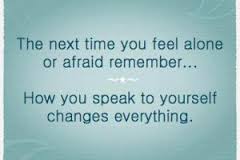
Staying Positive on Tough Days

Leave a comment »

gratitude 5Ever had a day where everything seemed to go wrong.  You woke up overwhelmed thinking about all the things you had to do.  You couldn’t find what you needed.  Your family was crabby.  You got out the door late.

Then, it seemed like the whole day followed suit.  Too many demands and not enough time.  People are so irritating and upsetting and it seems like it just wasn’t meant for you to have a good day.

On days like this, it can be hard to see the good in our life!

Here’s a mental technique you can use to turn your day around.

POSITIVE FOCUS

Think of one great thing (no matter how small)

“My hair actually turned out pretty good today!”

“My car worked and got me to where I needed to go.”

“At least I had a family to be crabby.”

“I have legs and arms that work” (some people don’t)

Sometimes if it’s a really hard day, it can be hard to get the ball rolling, BUT, with each SMALL ITEM you think of to be GRATEFUL for, you start to have a COMPOUND effect.  As you switch your FOCUS to gratitude, you will start to feel better and think of even MORE to be grateful for!

It’s a SIMPLE, EASY  technique to turn your feelings around!!

We frequently take the small things for granted, yet research shows that being able to acknowledge and appreciate the small things in life are one of the SECRETS of HAPPY, SUCCESSFUL PEOPLE.

Focusing on all you have to be grateful for will SHIFT your ENERGY back to a POSITIVE place!

If you’re upset with someone, make a list of all the qualities you like about that person.  It will calm you down and balance your emotions.

It will make you feel more optimistic, and when you feel more optimistic, you will feel better and your day will go better!!

It will set up your energy for greater success and help you get through a TOUGH day.



Keep your attention where your feet reside!

Leave a comment »

present momentDoes your head ever replay old scenes from your life?

Remember that embarrassing time when……?  Remember how Joe talked to you……? Remember how dumb you acted when………..?  Remember last year when you screwed up and so and so was so upset with you……………? Remember how humiliating it was when………?

And, on and on the memories of the past go.

Does your head ever imagine worrisome, stressful events in the future?  

What if this goes wrong and it ends up a mess…………?  What if such and such happens………?  What if I’m never able to lose weight, be successful, be in a good relationship, get along with my family, get all my work done, get my life together, figure it out, etc., etc…..

When you replay the past, you feel sad, depressed, disappointed.

When you play out the future, you feel anxious, worried, overwhelmed and stressed.


present moment 3


Research shows the key to success and happiness, to less emotional difficulties, to living an easier life is to be in the “Here and Now”–to live in the Present Moment!


Here are three steps to help you live in the Here and Now……where your feet reside!


Step One

Be conscious of your thinking.  Whenever you find yourself thinking of the past, notice and acknowledge it and then use self-talk to pull yourself back to the present moment and to what is happening now.

 “There I go again, remembering something embarrassing in my past or something awful that someone said to me.”

 “It’s over and done and I’m going to let that go and focus on right here and right now.”

Step Two

Use self-talk to remind yourself to be thankful for the lessons you learned from past events.

“Each and everyone of those experiences helped me to become who I am today.  They were all growing experiences in my life.”  “I’m thankful for all the learning opportunities.”

“Now I choose to learn what I can from them, let them go, and live in the present moment.”

“The past is done and gone and I will choose to focus my energy and thoughts on the present moment.”

The more you use this self-talk, the easier time you will have letting go of the thoughts about the past.

Step Three

Make an effort to completely focus on your current environment and tasks at hand.

Feel the chair you’re sitting on, the floor you’re standing on.  Notice the furniture in the room, listen to the noises around you, really see and hear what is going on in the present.  Put 100% attention on what you are doing, whether it’s cleaning, writing, visiting–give it all your focus.

Focusing on your surroundings and what you are doing now is a great way to get your head out of the past and future and back to the present moment.

Like anything, the more you practice this, the better you will get at it!

Before you know it, you’ll significantly reduce the amount of time you spend in the past or future!  Your life will be easier for it!


23 Reasons to Be Optimistic

Leave a comment »

positive-thinking-bHere are some reasons to be optimistic:

  1. Optimists live longer

  2. Optimists travel more often and more widely

  3. Optimists do better in school

  4. Optimists are better at sports

  5. Optimists often make the right decision

  6. Optimist are better at business

  7. They have better immune systems and they’re less likely to catch colds

  8. They are happier

  9. They have healthier hearts

  10. They breathe more easily

  11. Optimism has a positive effect on overall health

  12. Optimists bring out the best in themselves and the best in others

  13. Optimists are more social

  14. Optimists maintain better relationships

  15. Optimists make other people feel more worthwhile

  16. Optimists inspire others

  17. Optimists are more relaxed

  18. Optimists are open to new experiences

  19. Optimists are more stress-resistant and resilient

  20. OPTIMISTS ARE MORE SUCCESSFUL

  21. Optimists are surrounded by happy people more often

  22. Optimists enjoy life more

  23. Optimism moves you forward

Optimism gives you control over your circumstances versus your circumstances having control over you!


(Intelligent Optimist, Vol II, issue 3, 2013.)

5 Strategies to Self-Compassion

Leave a comment »

self compasssionMost of us were taught that you should have COMPASSION for others, but were you taught that you need to have compassion for yourself first?

Most of us weren’t.  The truth is, until you have compassion for yourself, you won’t be able to have it for others.

We often “bash” ourselves for not being “good enough” and think self-criticism will help us get better.

Research has found that self-criticism, beating ourself up, only sabotages us.  There’s actually NOTHING MOTIVATING about criticizing yourself. It makes you feel negative about yourself and it can lead to low confidence, anxiety and depression.

Self-compassion, on the other hand, helps you feel better.  When you feel better, you do better and you have an open mind towards solutions.

What is self-compassion?  It’s being warm, kind and understanding toward ourselves when we suffer, fail, or feel inadequate.

When you are compassionate to yourself, you realize that being imperfect, failing and having difficulties in life is inevitable.

5 Strategies for Self Compassion

1.  Consider how you’d treat someone else.  Imagine what you’d do if someone you cared about came to you after failing or getting rejected.  What would you say to that person? How would you treat them?

2.  Watch your language.  You may be so used to criticizing yourself that you don’t even realize that you’re doing it.  It helps to pay attention to the words you use to speak to yourself.  If you wouldn’t say the same statements to someone you care about, then don’t say it to yourself.

3. Memorize a set of compassionate phrases. If you find yourself saying, “It’s horrible.” or “I’m horrible” –that’s not very compassionate. Try some of the following phrases instead.

  • No one is perfect; everyone makes mistakes from time to time.
  • It’s normal to have ups and downs.
  • It will be ok and I’m ok–I’ll just do better next time.
  • I did the best with what I knew at the time.
  • I’m still a good person; I’m a human and humans aren’t perfect. 

4. Acknowledge and accept all of your feelings, whatever they are–anger, sadness, fear, resentment, envy.  Once you accept and allow them, they will be free to move on.  When you resist feeling them, they tend to persist.

5.  Give yourself the love you crave from others.  When you begin to feel your OWN love, you will realize how much energy you’ve put into trying to get love and compassion on the outside. No matter how much love and compassion you receive from someone else, it will never be enough to replace your own self-compassion.

As you give yourself more compassion, you will trust yourself more to take care of you!  You will have healthier boundaries with people and not depend on them to take care of you.

Another positive outcome of practicing self-compassion is your compassion for others will flow freely and effortlessly.  Once you’ve experienced compassion for yourself, you will have it to share with others.